Friends, Kremlin spokesman Dmitry Peskov recently revealed Russia's conditions for ceasing its invasion of Ukraine. My latest article considers those conditions and recommends that Ukraine and the West take Russia up on its offer. We need to end this conflict ASAP, before more damage is done to Ukraine, to the economies of Ukraine and Russia, and to the prosperity and security of the world as a whole. See what you make of my point of view.
A Ray of Hope: Russian Proposals
Offer a Way Out of Our Common Predicament
Early
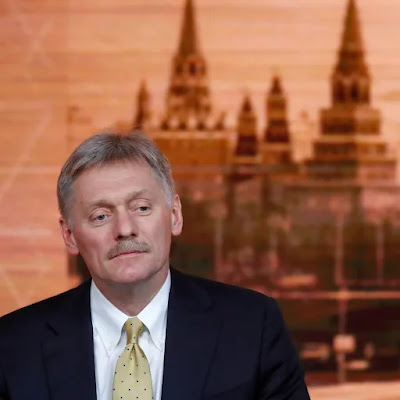
this week, Russian spokesman Dmitry Peskov made
explicit
the terms under which his country would be willing to cease its
invasion of Ukraine. Peskov said that Russia insists that: the
Ukrainian military lay down its arms, Ukraine's constitution be
amended to guarantee the country's neutrality, Crimea be recognized
as part of Russia, and the breakaway republics of Donetsk and Luhansk
in Ukraine's east be recognized as independent.
While
anti-Russian zealots in the West, and fervent Ukrainian patriots, may
balk at these demands, they nonetheless reveal a path by which
Russia, Ukraine, NATO, and the United States could reverse the
current momentum favoring constant escalation in fiery rhetoric,
harsh economic sanctions, and direct military action. We should, in
fact, consider meeting some of Russia's demands, or encouraging the
Ukrainians to do so, in order to unwind the toxic dynamics of a
conflict that, arguably, serves the interests of no one.
Russia's demand
that the Ukrainian military cease its operations amounts to a
proposal for an effective ceasefire. Many such ceasefires have been
proposed in the course of the long-running war in eastern Ukraine,
and in the course of more recent hostilities, but few have worked, in
practice. Nonetheless, if sufficient will exists on both sides, the
termination of active fighting is achievable.
Russia's demand
that Ukraine pledge its neutrality, forswear NATO membership, and
enshrine these commitments in its constitution, represent the core
Russian proposal, the spurning of which necessitated, in Putin's
eyes, the invasion of Ukraine in the first place. Ukraine was
encouraged by the West to reject Russian suggestions that Ukraine's
burgeoning ties with NATO and the EU represented a threat to Russian
security. Ukraine is now reaping the bitter harvest that such
well-meaning advice has produced.
It is hard to see
why Ukraine would not have agreed to pursue a neutral
political-military course before Russia launched its invasion, given
its obvious exposure to Russian political, economic, and military
power. Now that the very survival of Ukraine as an independent state
has been cast into doubt, one would think that the arguments for a
policy of strict neutrality have become, if anything, even more
compelling.
Ukraine should
agree to give up its ambitions of joining NATO, and if necessary the
EU as well. Positive, fruitful relations between Ukraine and the West
can and will be achieved, but only if Ukraine gets its house in order
in terms of Russia-Ukraine relations and avoids provocations that
offend its much more powerful neighbor. Simply put, Ukraine cannot
prosper, and it may not even endure as a country, unless it finds a
way to coexist amicably with Russia.
Probably, if
Ukraine had learned these vital lessons earlier, it would not be
facing the more-or-less inevitable loss of its pro-Russian regions,
including Crimea, Donetsk, and Luhansk. Ukraine should accept that
these areas will not again come under its direct control. Formalizing
its loss of sovereignty over Crimea, Donetsk, and Luhansk would, as a
matter of fact, be preferable to leaving these regions in political
limbo, and thus leaving open the possibility that their status might
be resolved in future by military means. Forfeiting these areas is
thus the price Ukraine must pay for a comprehensive, lasting solution
of its poor relations with Moscow. It is a price worth paying,
especially given the fact that Russia is militarily capable of taking
even more of Ukraine and of causing far greater harm, to vulnerable
Ukrainian civilians and to Ukraine's vital infrastructure and social
and economic fabric.
Western leaders
are clearly now in the full bloom of moral indignation against
Vladimir Putin and the Russian military. Their outrage and their
anger will make it difficult for them to make clear-headed decisions
about what is best for Ukraine, for NATO, for the West, and
ultimately for Russia, too. The current conflict is one which
imposes, or could impose, horrific damage on all the interested
parties. The longer the conflict goes on, moreover, the more the
Ukrainian and Russian peoples will suffer, albeit in different ways.
Worse, the longer the conflict lasts, and the more it escalates, the
greater is the danger of a fatal miscalculation leading to armed
conflict between Russia and NATO, the full consequences of which
would be horrific in the extreme.
Leaders in
Ukraine, Russia, and throughout the West should thus consider the
risks of proceeding on our current path, and they should make
affirmative decisions to change course. The differences between
Russia and Ukraine are far from irresolvable, and they need not –
must not! – drag us all into World War III.
Now is the moment
for statesmanlike leaders to step back from the brink, therefore,
before the war of words between Russia and the West becomes a
shooting war, and stakes considerably graver than the peace,
prosperity, and freedom of Ukraine are on the line.
Dr.
Nicholas L. Waddy is an Associate Professor of History at SUNY Alfred
and blogs at: www.waddyisright.com.
He appears on the Newsmaker Show on WLEA 1480/106.9.
To complement my article, here's a very good analysis of the economic risks the West is taking by throwing everything but the kitchen sink, sanctions-wise, at Russia all at once:
https://www.politico.com/news/magazine/2022/03/08/west-gamble-financial-war-russia-00015156